What is a footballer life simulator?
Updated:
In short
In a footballer life simulator you guide a single player's life, not a whole club. The weight of the game sits in your decisions more than in your reflexes. Training, contracts, money and choices off the pitch shape where the career goes.
What is a footballer life simulator?
A footballer life simulator is a game where you live a single player's career from start to finish. You do not build a squad or pick a line-up. You are the person walking onto the pitch, and the story moves forward through the choices you make.
Time in this genre usually passes season by season. Around each season you face decisions: which part of your game to work on, whether to accept an offer, where to spend the money you have earned. Most matches are worked out in the background and you see the outcome. Some games hand the key moments to you, while others tell everything through text.
The appeal is that every career ends up somewhere different. People who start with the same player make different choices and live different lives.
How is it different from a football management game?
In a management game you run the whole club. In a life simulator you only run yourself. The difference is the seat you sit in: the manager's office, or a single peg in the dressing room.
That changes the questions the game asks you:
- A management game asks which player to sign and which formation to use.
- A life simulator asks whether to take this offer and whether you can get along with this coach.
- In a management game a transfer is a purchase. In a life simulator it changes your life.
- In a management game players are rows in a list. In a life simulator you have a family, friends and an agent.
If you are curious how a move looks from the player's side, read our guide to football transfer types.
How is it different from a match game?
In a match game the result depends on your hands. In a life simulator it depends on your decisions.
In a life simulator the player's attributes matter. Even with quick fingers, a young player with modest ability cannot turn every chance into a goal. You have to develop them, choose the right club and keep them fit. That is why the genre suits people who enjoy patience and thinking long term.
Some life simulators blend the worlds. The match as a whole is calculated, but control passes to you for moments such as a free kick or a penalty. Both your decisions and your touch then play a part.
What should you look for in a game like this?
Start with how much the game leaves to you. In a well designed life simulator your choices have consequences and the game remembers them, sometimes seasons later.
Other things worth checking:
- Depth: are contracts, transfers and agents close to real life, or skipped with a single button?
- Life off the pitch: do money, home, family and image have a place in the game?
- Variety: does each new career begin somewhere different, under different conditions?
- Pace: does the game suit short sessions, or does it expect long stretches at the screen?
- Payment model: do things bought with real money affect match results?
- Accessibility: can you skip or ease the hands-on sections?
If realism matters to you, look closely at how the game handles market value and the relationship with your agent. When those stay shallow, a career soon starts to feel the same every time.
How does this work in Kickhood?
Kickhood is a footballer life simulator and it is not released yet. It is being prepared for iPhone. What follows is the general way the game is designed to work.
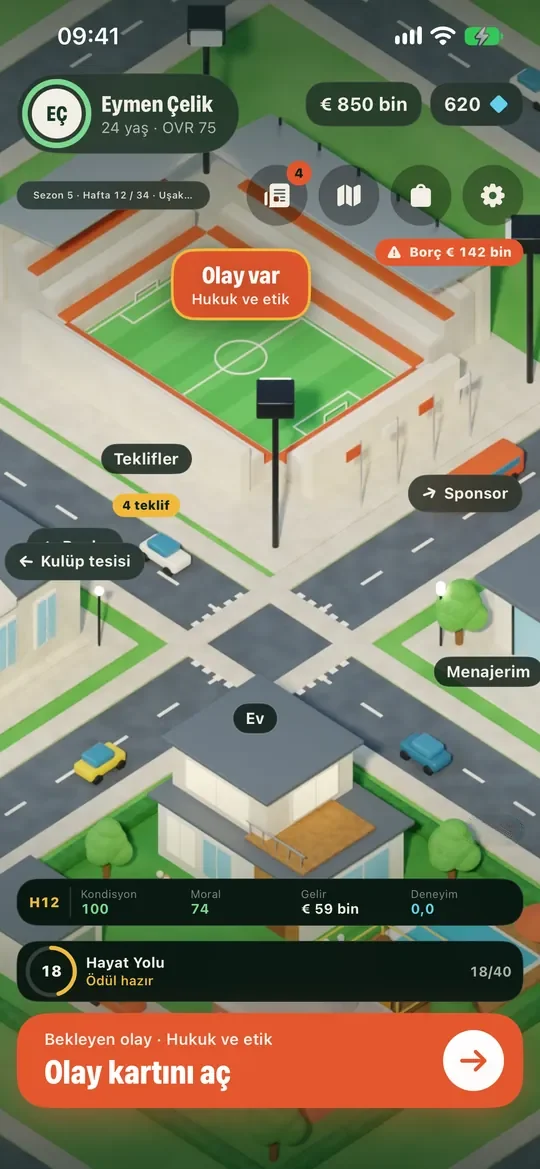
You begin life in a randomly chosen family. Each year is a turn: decision cards arrive in the summer break, you hand out development points, spend your money and play the season. You can follow the season match by match or move through it quickly.
Matches are calculated, but you play key moments such as free kicks, penalties, headers and one-on-ones with your own finger. The outcome does not rest on your touch alone, because the player's attributes count too. You can also let these moments play automatically.
There is a life away from the pitch as well. You choose a home on the city map, agree deals with sponsors, see contract offers item by item and negotiate them. You pick an agent as a teenager, and we explain why that choice matters in what does a football agent do.
You can follow progress on the home page.
FAQ
Do you need to know football to play a footballer life simulator?
No, the basic rules are enough. Games in this genre show you the options and explain what follows from them. You pick up ideas such as contracts and transfers as you play, and our guides give a short explanation whenever a term is new to you.
Do you play the matches yourself in these games?
It depends on the game. In some, the entire match is calculated and you only see the result. In others, certain moments such as set pieces are left to you. Kickhood is designed the second way: the match is calculated and the key moments are played by hand.
How long does a career last?
It varies a lot between games. Some finish a whole career in a single sitting. Others want you to come back to the same career a little each day. Think about your own habits when choosing.
Is a life simulator the same as a career mode?
Not quite. A career mode is usually a section inside a match game, and its weight is still on playing the match. In a life simulator the career is the game itself, with decisions off the pitch, money and relationships at the centre.
This article is general information, not legal or financial advice. Rules differ by country and league.